

How We Built Taste of Türkiye: A Headless Website Run by AI
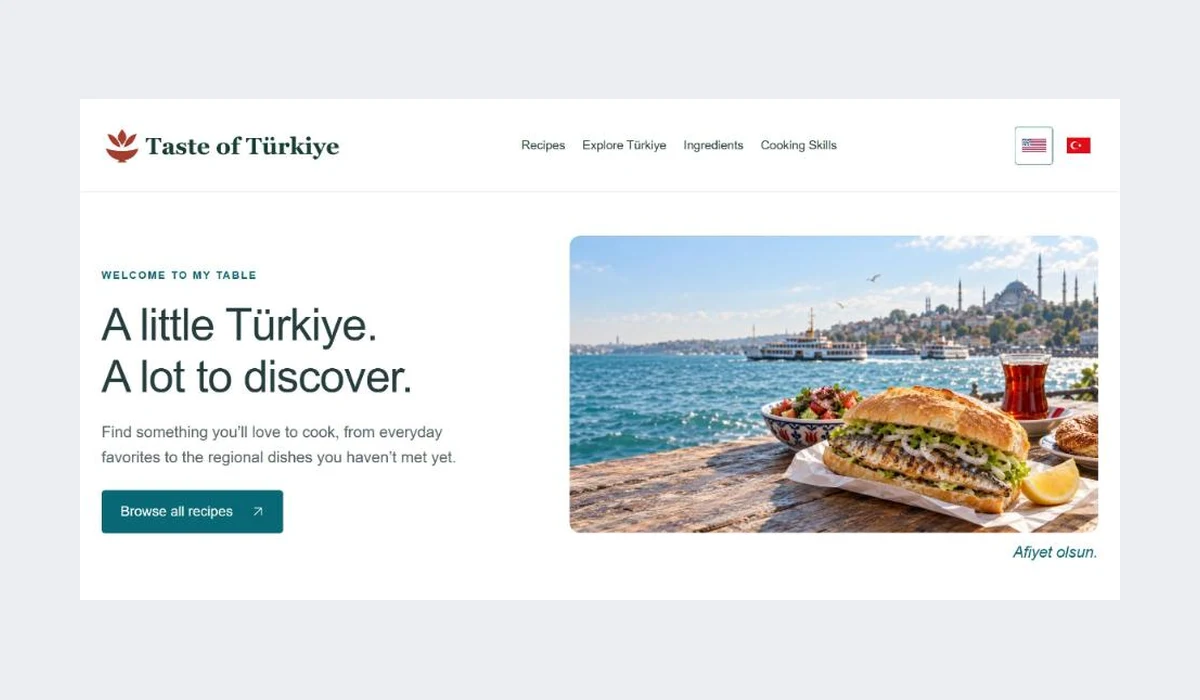
Taste of Türkiye is a bilingual English and Turkish website about Turkish recipes and regional food culture. It looks like a simple recipe site, but under the hood it is a good example of two ideas that matter to every organization planning a website today: a headless architecture and AI working inside a controlled process.
Here is how it is built, what it does, and what we learned.
What the site includes
- About 185 recipes, each published in both English and Turkish
- More than 220 ingredient guides, linked from every recipe
- Pages for Türkiye's provinces and their signature dishes
- Cooking-skills lessons, search, recipe ratings and a newsletter
In total, the site serves more than 1,000 pages in two languages.
What "headless" means
A traditional website builder such as Squarespace or WordPress keeps the content, the design and the hosting in one product. That is convenient at first, but it ties everything together: the content can only be shown the way that product allows.
A headless site separates them. The content lives in a dedicated content system, and the website (the "head") is a separate application that requests the content and displays it. The same content can feed a website, a mobile app, search or a newsletter, and each part can be improved without rebuilding the others.
The building blocks
- Sanity, the content system. Recipes, ingredients, translations, images and editorial records are stored as structured content, not as page layouts. A recipe has fields for ingredients, quantities, steps, timings and its Turkish and English versions.
- Next.js, the website. Pages are built on the server, so search engines receive the full recipe text in the page itself.
- Vercel, hosting. Every approved change is deployed automatically, and every proposed change gets its own private preview link before it goes live.
- Algolia, search. Recipes and ingredients are synchronized to a search index so visitors find dishes by English name, Turkish name or ingredient.
- Upstash Redis, ratings. Visitor ratings are stored in a separate private database, called only from the server.
- Resend, the newsletter, sending from its own subdomain with proper email authentication.
- Vercel Web Analytics, for privacy-friendly visitor statistics without cookies.
Each service does one job well, and each can be replaced without rebuilding the whole site.
A website run by AI, with rules
The most unusual part of Taste of Türkiye is how the work gets done. Most of the day-to-day development and content work is carried out by AI agents from several providers, including OpenAI Codex, Anthropic's Claude and Google's Gemini, plus a scheduled worker that picks up routine tasks on its own.
That only works because the AI operates inside a process with clear rules:
- A shared task queue. Every task is a GitHub issue. Agents claim one task at a time, so two agents never work on the same thing, and every decision is written down. The project has handled more than 2,000 issues so far.
- Small, reviewed changes. Each change goes to its own branch and becomes a pull request automatically. More than 1,000 changes have reached the live site this way.
- Automatic checks before anything goes live. A required "gate" builds the site and runs tests on every change, and a separate check opens the preview link to confirm that real pages load. If a check fails, the change does not merge.
- Publication rules for content. A recipe cannot be published without an approved photo, a cooking time, both languages and a working guide for every ingredient. The content system enforces this, so it cannot be skipped.
- Cross-checking between AI models. New recipes and recipe changes are reviewed separately by two different AI models against the research before they can be approved.
- A human owner. The owner sets direction, approves new images and policies, and makes the decisions that matter. The AI does the work; the rules and the owner decide what ships.
What we learned
- Structure first. Treating content as structured data rather than pages is what makes two languages, search and automation possible.
- AI needs guardrails, not freedom. The results come from clear rules, automatic checks and an approval step, not from a clever prompt.
- Write everything down. Decisions recorded in the task queue let any agent, human or AI, pick up work without the original conversation.
- Small and frequent beats big and rare. Many small, checked changes are safer than occasional large releases.
Why this matters for finance teams
These are the same disciplines that make a month-end close reliable: defined steps, controls that cannot be skipped, reconciliations, and sign-off by an accountable person. The approach behind Taste of Türkiye carries over directly to AI automation for finance, such as reconciliations, variance commentary and report drafting, where AI prepares the work and people review and approve it.
If you are thinking about a modern website, moving off a website builder, or putting AI to work safely in your finance processes, get in touch. We would be glad to share what we learned.